
When a photograph tells a story…
I love studying my family history. Genealogy has always been important to me, and I’ve always loved knowing where I came from.
But there’s something about genealogy that changes when you add a photograph.
Names, dates, places, births, marriages, and deaths tell us the facts of our family history. But so often, we don’t have a face to go with those dates. I think that’s one of the reasons I love old family photos so much.
Suddenly, there is a person behind the dates. And when there is a person, there is a story.
My Families Journey From Germany to Russia to Idaho
Growing up, I always heard the story of my maternal grandmother’s family and their journey to America. My ancestors were part of a German community that had settled in Russia during the time of Catherine the Great. Generations later, during a period of tremendous upheaval in Russia, the family left and eventually immigrated to the United States.
Their identity was a melding of different places and cultures. They had German roots, generations of history in Russia, and then they became Americans. And somehow, after crossing countries and an ocean, they ended up in a small town in Idaho. I still don’t know exactly how they chose Idaho.
But they homesteaded there, built a life, raised their family, and put down roots. Generations of our family have remained connected to that area ever since.
The Photograph That Made Their Story Real
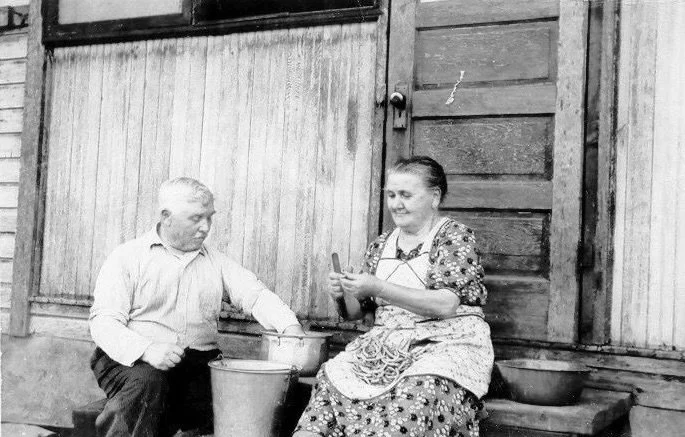
One photograph of my great-great-grandparents has always meant something special to me. My grandmother shared it with me after I was married, and I have displayed it in my home ever since. It isn't a formal studio portrait. They aren't dressed in their finest clothes, posed stiffly for the camera. They are simply sitting together on the porch of their home, cleaning beans for dinner.
Such an ordinary chore. And maybe that is exactly why I love it so much.
These two people—and the generations before them—had traveled across countries. Their family had experienced political upheaval, immigration, uncertainty, homesteading, and the challenge of creating a new life in a completely different place.
And here they are. Sitting together on their porch. Cleaning beans for dinner.
More Than an Old Photograph
When I look at this photograph, I don't just see two people I never had the opportunity to know.
I see my family. I think about where they came from, what they experienced, and everything that had to happen for them to eventually be sitting on that particular porch in Idaho. I wonder what they talked about while they worked. Was this something they did together regularly? Were children or grandchildren running around nearby? Was it a warm summer evening? Did they ever stop and think about how far their family had traveled to arrive at this quiet moment?
I'll never know all of those answers. But I have the photograph. And because I know their story, that photograph means so much more.
This Is Why Family Photos Matter
Genealogy gives us names, dates, locations, and relationships. Those things are incredibly valuable because they help us understand how the pieces of our family history fit together.
But photographs give those names faces. They remind us that our ancestors weren't simply entries on a family tree. They were real people who cooked dinner, sat on porches, worked, laughed, struggled, raised families, and lived ordinary days. Sometimes we become so focused on preserving the big moments that we forget how meaningful the ordinary ones can become.
A photograph of two people cleaning beans may not have seemed particularly important when someone took it. Generations later, it is priceless to me. That is the power of a family photograph.
When you know the story behind the picture, you're no longer looking at a photograph. You're looking at your family history.
Start with the Date: A Simple Photo Organizing Fix That Changes Everything
A few weeks ago, I found myself on a mission: I was trying to locate a single photo from a recent vacation. Just one! I opened up my iPhoto albums and started scrolling…and scrolling…and scrolling. I was a little embarrassed to realize that I hadn’t named most of my albums in any useful way.
There were at least four albums labeled “Thanksgiving” and a solid ten named “Christmas.” Not helpful. At all.
So I finally did what I’ve been meaning to do for ages — I reorganized. I renamed every album and photo file using a system that’s now my gold standard:
YYYY-MO-DY_Subject and Topic
And wow. What a difference. Suddenly, all of my albums were in beautiful chronological order. Everything made sense. I could find exactly what I needed without the guessing game. It was actually fun to see the timeline of my memories unfold in order.
Here’s the best part — it didn’t take long at all. Once I committed to it, the process went quickly. Just a little bit of consistency made a huge impact.
So here’s my advice to you: Start now.
Whether you’re organizing photos on your phone, your computer, or a backup drive, give every file and folder a date first. Even if you're filing inside a sub-folder like “Vacations” or “Family Events,” using the date format helps keep things tidy and searchable.
Trust me — future you will thank you when you're trying to find that one picture from a beach trip, birthday party, or big milestone.
If organizing your photos feels overwhelming, you’re not alone. That’s exactly why I started Snapshot Photo Management. I help people like you preserve, organize, and safeguard their memories for generations to come. Want to get started but not sure where? Let’s chat.

Back-to-School Photos: A Tradition Worth Keeping (and Keeping Safe!)
Well, it’s that time of year again—school is starting! One of my favorite traditions has always been taking a first day of school picture. It’s how I’ve tracked my boys from preschool to high school, and even into college. As our family has grown, my daughters-in-law have joined in, sending me pictures of their kids’ first day too. It’s such a fun way to capture those milestones and watch how everyone changes over time.
But as we dive into the excitement, let’s talk about a few things to keep in mind:
1. Protect Your Privacy
If you’re using those cute chalkboards or printable signs that list details about your child, make sure the information is safe to share. Avoid including the name of their school, teacher, or any location details. And before posting online, consider turning off your photo’s GPS data so it can’t be tracked. Keeping our kids safe while still enjoying these traditions is always the priority.
2. Create a First-Day Album
Make life easier on yourself—set up a digital or printed album for each child. Every year, simply add their first day of school picture to that album. Over time, you’ll have a complete collection of their school years in one place.
3. Celebrate the Journey
When each of my boys graduated from high school, I loved pairing their very first first day photo from preschool with their high school first day photo and their last day of school picture. It was such a special way to see just how far they had come—a beautiful walk through time.
This school year, keep the tradition alive, keep your kids safe, and keep those memories organized. Because one day, you’ll look back and be so glad you did.

How to Store Your Photos Safely: Archival Storage Tips
Preserving family memories is one of the most meaningful things you can do—but if your photos are stashed in hot garages or dusty attics, they’re at serious risk of damage. Whether you're just beginning your journey into photo organization or deep into digitizing your collection, here are essential tips to store your photos the right way.
Get Them Out of the Heat
High temperatures and humidity are the enemies of photographs. Never store your photos in the attic, garage, or basement. These spaces are prone to extreme temperature changes, moisture, and even pests. Instead, look for a temperature-controlled space, such as a bedroom closet or interior room, that’s free from direct sunlight and moisture.
Use Archival-Quality Boxes
To truly safeguard your photo collection, use archival storage boxes. These acid-free, lignin-free containers are designed to protect against deterioration. They provide a stable environment that reduces exposure to light and airborne pollutants, both of which can cause fading and brittleness over time.
You can purchase archival boxes online at retailers like Amazon or specialty shops such as Archival Methods. These are the same types of products professionals use when organizing and returning photo collections to clients.
I’ve personally started moving my entire photo collection into archival boxes—and I highly recommend you do the same. When working with clients, I always return their collections in archival-safe products. It’s a small investment that pays off by preserving generations of memories.
Bonus Tip: Digitize What Matters Most
In addition to physical storage, begin digitizing your most valuable photos. Focus first on the images that would break your heart to lose. Scan them at 300–600 dpi as JPEGs or TIFFs to maintain quality, and back them up using the 3-2-1 method:
3 copies of your data
2 different types of storage media
1 copy stored offsite or in the cloud
By combining archival storage with digital backups, you can ensure your family’s legacy is safe for years to come.